| |


|
The History of the Osek Monastery
The more than 800-year history of the Osek monastery is a mirror
of the Bohemian and European past, a varied up and down, to which
years of prosperity and influence belong, as well as times of
hardship and decline. Remarkably, the Cistercians always returned
to Osek and faced the challenges of a new beginning.
Osek owes its unique and still vital monastery to the dedication
of the monks and the vision of the abbots. Shortly after it was
founded in 1098 in Citeaux in Burgundy, the Order of the White
Monks became a driving force for Christianity and spread its
knowledge of agriculture, forestry, water management, architecture
and progressive craftsmanship throughout Europe.
At the invitation of Slavko the Great, chamberlain of the Kingdom
of Bohemia and burgrave in Bilin, the Cistercians came from Waldsassen
in the Upper Palatinate and founded the Osek monastery in 1196.
The construction of the stone monastery began with the Romanesque
abbey church, built between 1206 and 1221. The convent buildings,
whose styles mark the change step by step from the Romanesque
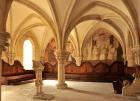
to the Gothic, followed. The east wing, with its famous chapter
room, was built under Slavko of Hrabischitz, the grandson of
the founder, who became the first Bohemian abbot of Osek.
The continual advancement of the Osek monastery ended with the
Hussitic wars. The first sacking of the abbey occurred in 1421,
only a few monks survived a second attack in 1429. From then
on, the monastery led a meager existence, selling off more and
more of its goods, until in 1580 - with only six monks living
in the deeply indebted monastery - it was finally closed and
became the summer residence of the archbishops of Prague for
46 years. Osek was returned to the Cistercians in 1626.
The Osek monastery reached its full potential following the
Thirty Years' War. In 1650, Laurentius Scipio took charge and
led the abbey through four very successful decades, laying the
groundwork for centuries of prosperity and sustained influence
in northern Bohemia. The church that had been burned during the
war was restored and the workshops, dairies, and working quarters
were rebuilt.
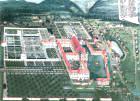
A large vegetable garden and orchard was laid out to the west
of the monastery. The successor of Scipio was able to dedicate
himself to improving the abbey from the stable, economically
viable foundation that had been left to him. Benedikt Littwerig,
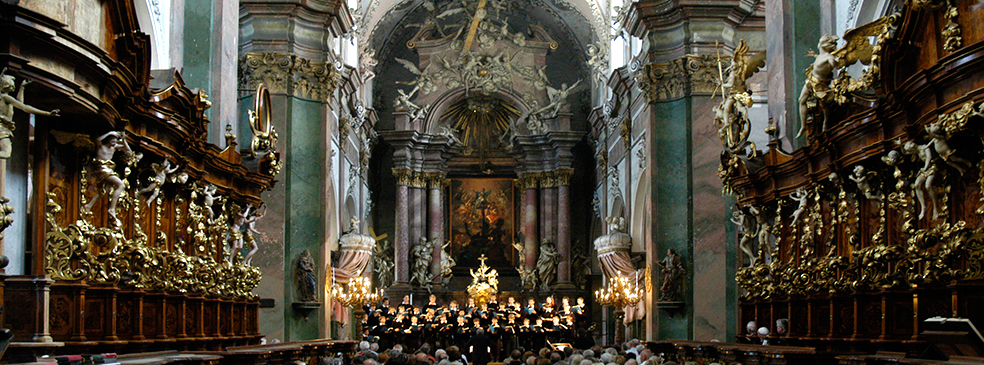
abbot from 1691 to 1726 initiated the Baroque reconstruction,
expansion and decoration that give us the image of the abbey
that we have today.
The leading builders of the day, Giulio and Octavian Broggio,
were won for the con-struction. Six years were needed before
the detailed redesign of the church was completed in 1718. A
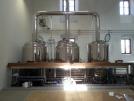
prelature, brewery, li-brary, apothecary, and a first textile
factory were added. Abbot Hieronymus Besnecker added the large
Baroque gardens: in 1726, the abbot's garden in front of the
east wing of the new prelature and in 1728, the convent garden
south of the monas-tery.
Abbot Mauritz Elbel successfully defended Osek - one of only
two Bohemian Cistercian monasteries - against the exerted reform
attempts and the closings of monasteries by Kaiser Josef II in
1783. The abbot started the portrait gallery and the natu-ral
science cabinet, had the abbot's room lavishly redecorated, and
expanded the garden to this size it remains today.
The 19th century saw the monastery become a place of literature
and science, of social and religio-political involvement and
an economic undertaking that generated money from coal-mining,
orchards and leases on its considerable agricultural holdings.
In the years 1875 to 1877, under the abbots Sales Mayer and Ignác
Krahl, the monastery was completely renovated and the gar-dens
were redesigned in the landscape style. Under Abbot Theobald
Scharnagl, the monastery survived both world wars and the reduction
in its property holdings during the agricultural reforms of 1921.
In 1943 Abbot Eberhard Harzer took over the monastery; together
with the German monks, he was interned in 1945 and deported to
Austria in 1946.
Salesians lived in the monastery until an internment camp was
set up in 1950 for ordained priests, and in 1953, for Czech nuns
of various orders. New Cistercian life returned to the old walls
when the monastery was reordained after the collapse of Com-munism,
and in 1991 - after a 46-year interruption - Bernhard Thebes
became the 45th abbot at Osek. With the support of many people,
he has dedicated himself, above all, to the revitalization of
the Christian faith, the care of the homeless, and the renovation
of the considerable historic structural fabric of the monastery.
|


|